

Urban Issue(s) 2.12
NFTs: Nana Financing Today

Hi friends,
I’m trying something a little different this week and I’d love to know what you think. Once or twice a month, I am going to do a deep dive into an issue affecting cities rather than the news roundup. My usual Friday routine is to give my take on something happening in the world related to urban life and pair it with 3-4 stories from the week. I think there is an opportunity, though, to dig a bit deeper into niche topics and present a different way of thinking about them. You’ll find loads of footnotes at the bottom, along with two Twitter profiles of interesting people working on the issue.
To kick things off, we’ll be taking a deep dive into eldercare.
The Big Boom
I spend a lot of time thinking about people who live in cities and how to improve their experience. One of the most underserved groups in urban environments is the elderly. Today there are roughly 52 million people in the United States over the age of 65. By 2060, this number will nearly double to 95 million.1 This is a staggering and looming issue for cities.
As I was researching this topic, my curiosities took me through the origins of nursing homes, how elder care is funded in the U.S. and abroad, and whether there are models of care that can address this boom. TLDR: Countries are woefully underprepared to provide compassionate care to the elderly and cities do not have the autonomy they need to address this at the local level.
To understand the current and future state of elder care, we have to go back to the origins of nursing homes. In the early days of America’s industrial era, it was common for all members of a household to work six days per week, 12 hours per day. The elder population was growing, but these demanding work schedules left families unable to care for their aging family members.2 Publicly funded Almshouses were established to provide daily care for seniors who could not care for themselves.
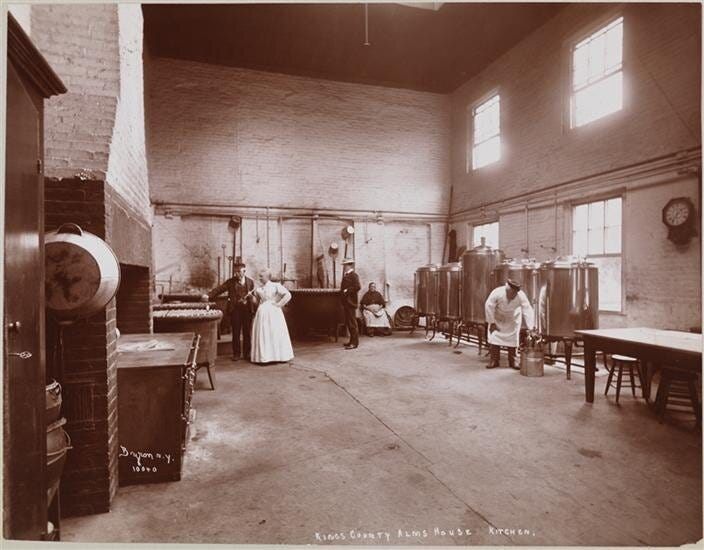
Fast forward to 1935, the United States invents the Social Security Act - a piece of legislation that does not support the funding of public eldercare facilities.3 This ignited private sector interest in nursing homes and started the ball rolling on an industry dominated by private players. Amendments to the Social Security Act allowing more federal spending on nursing homes were passed in 1960, and here’s the truly wild statistic:
“Between 1960 and 1965, federal spending on nursing homes ballooned from $47 million to $449 million a year. The advent of Medicaid in 1965 expanded nursing homes even further. Nursing home capacity more than doubled from 1963 to 1973.”4
The 2030 Problem
Ok, this is enough ancient history for me. Now that we understand the context, we can move on and talk about “The 2030 Problem”. In 2013, AARP released a report warning policymakers of a widening care gap that could leave millions of baby boomers without caregivers in their elder years.5 In layman’s terms, this report tells us that boomers live longer, go unmarried or get divorced, and become obese, meaning that they are more likely to need elder care and less likely to have the family structure to offer it. This leaves a looming gap for society that is only a decade away.
How do we move forward?
If you’re still with me, you are either an optimist like me or have a twisted sense of curiosity. Either way, let’s continue on.
To understand how we address this impending crisis, we have to acknowledge some hard truths about how elder care is funded. Currently, the eldercare industry is dominated by the private sector - companies that have shareholders to deliver to and a profit imperative to meet. This means that they are looking to maximize revenue and minimize expenses. The problem with this, in my opinion, is threefold:
Compassionate care and the provision of a decent quality of life are more expensive than providing the bare minimum. It is never the most profitable option to create something that goes beyond safe and livable. This results in stark, sterile, and understaffed facilities. The exception to this is wildly expensive private facilities that are inaccessible to moderate or low-income families.
Private elder care facilities minimize expenses by relying on underpaid, undertrained staff. This creates dangerous working conditions for people like CNAs and dangerous living conditions for residents who may not receive the level of skilled care they need. 59% of CNAs report being physically assaulted on a weekly basis. 65.8% of CNAs report being injured more than once per year.6
Compassionate care facilities that go above and beyond the minimum standard of care are usually funded by philanthropy. This lets the private sector off the hook and creates a perception that any elevated standard of elder care should be provided as a charitable service.
Is anyone doing this right?
As usual, we look to our Nordic friends for inspiration here. The world’s first Dementia Village was developed in the City of Weesp, Netherlands.7
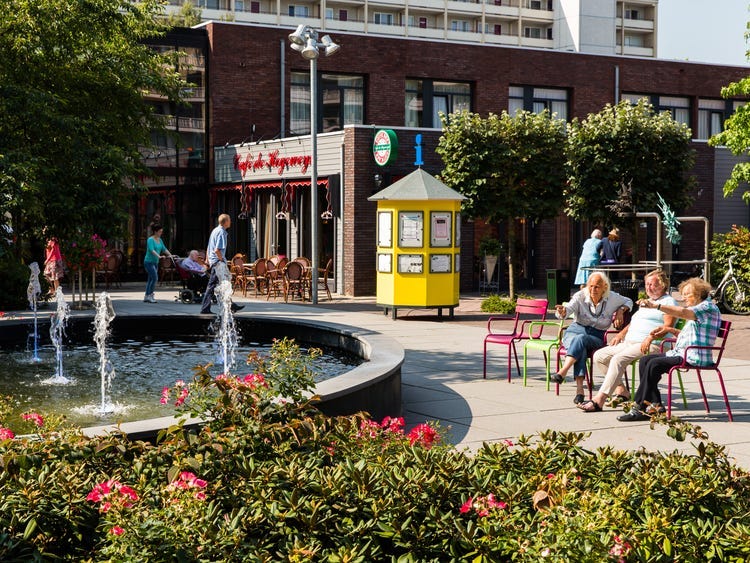
The De Hogeweyk model deinstitutionalizes elder care, meaning that there is no hospital-style care for residents. The Dementia Village is like any other neighborhood - it has a grocery store, a pub, a theater, and other fixtures you would expect to see in a small city. It is embedded within the city of Weesp, creating porous borders and allowing residents to interact with the street life and culture of the city.
“Van Hal insisted that Hogeweyk's residents — 150 live in the 3.7-acre village — are just as sick as people in U.S. nursing homes. They just look healthier because they're in a better environment.”
As progressive as this model is, it is still partially funded by philanthropy. In order to create sustainable models of eldercare that are humane and compassionate, we have to change the way the industry is funded. Today, public spending on elder care is embarrassingly low in the U.S. The United States spends 0.5% of GDP on long-term care, as compared to 3.3% in Sweden and 3.7% in the Netherlands.8 Not only is this embarrassing, but it also reveals a major vulnerability in our national budget as nearly 70 million baby boomers head toward long-term care.
What does this mean for cities?
Cities do not have much autonomy in financing eldercare since this is managed through Medicare and Medicaid at the federal level. Cities do, though, have quite a bit of control over the following leverage points: land use, social cohesion, and safety/security. Based on my research and analysis, I think there are three things that cities can do to lay the groundwork and prepare for an elder boom:
Amend land-use policies to allow for non-traditional development. Traditional zoning practices that have stringent requirements on setbacks and square footage minimums are not going to cut it. We need to make allowances for accessory dwelling units like granny-pods to give families the flexibility to provide a safe living space for their elders. We also need to design neighborhoods that take into account the vulnerability of children and elderly people - designing streets for cars rather than vulnerable humans is inhumane and poor planning.
Support and incentivize entrepreneurs who want to solve this problem. If there are any entrepreneurs out there looking for a gold mine idea, here you go. Uber is to Taxis as X is to Nursing Homes. This industry is ripe for disruption and cities should be looking for opportunities to partner with entrepreneurs in this space.
Fund projects and programs that spark social bonds between people across age groups. The social safety net created by bonds between people is invaluable. When young people have an opportunity to get to know their elderly neighbors, they will check on them. They will help them. They will become better citizens for it. It makes me crazy to see a public senior center miles away from the community centers designed for young people. Cross-pollinating residents of different ages benefits everyone.
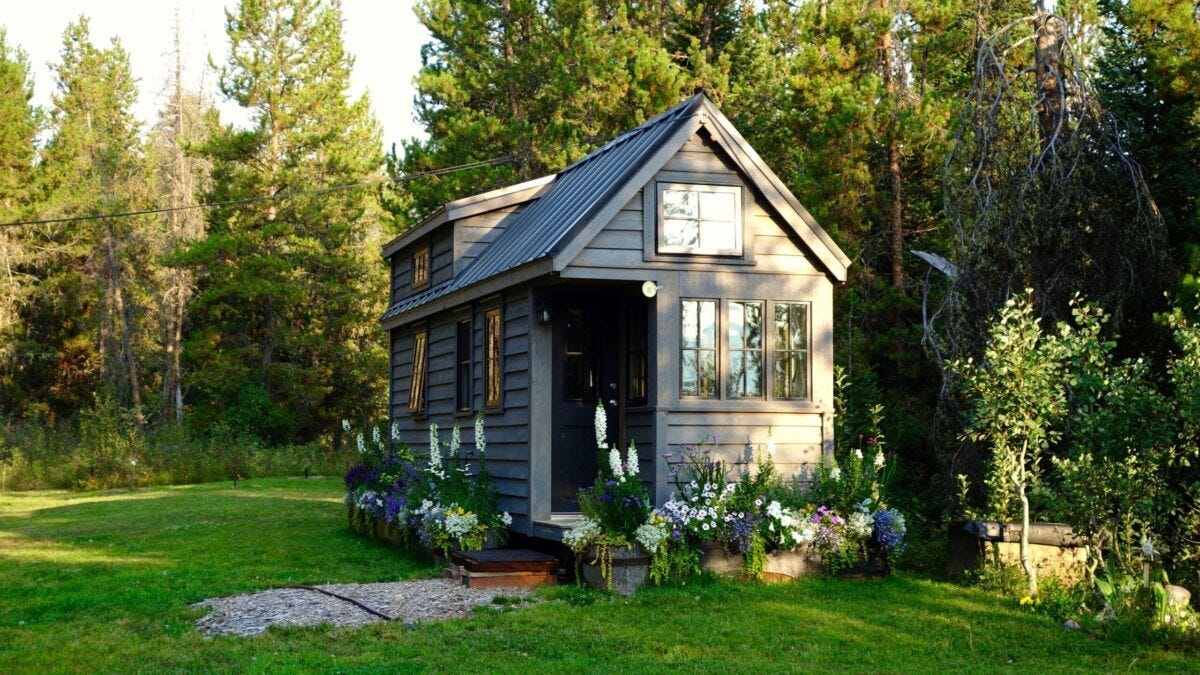
An accessory dwelling unit (or granny pod).
In Summary + People to Follow
Private eldercare institutions will always be most accountable to their shareholders and prioritize profit margins. This creates stark, lifeless, and sterile living conditions for our elderly neighbors and dangerous working conditions for their caretakers. To change this, we have to support models of care that are for-more-than-profit. Cities have a role to play in this and would be remiss to ignore the looming surge of aging people who will require long-term care.
If you’ve made it to the end of my first deep dive, I appreciate your companionship. I’d love to know whether you’d like to see more of these, and what topics you’re particularly interested in. I am certain that I have skipped over some excellent examples of people providing compassionate care to the elder community. If you know about something great happening in the world that I may have missed, please let me know by replying here or finding me @hialexjohnston on Twitter.
In my research travels, I found two great changemakers working in or adjacent to the long-term care industry that you should follow on Twitter: Erika Rief Hornstein and the amazing Ai-jen Poo. In the future, you can expect more of these recommendations paired with deep dives.


Until next week,
Alex
Currently Reading: Shaping Cities in an Urban Age
If you want more, check out my Flipboard magazine for a backlog of content.
To talk about this week's content, hit reply, or find me on Twitter at @hialexjohnston.
You can count on me to never sell or share your email addresses.
https://www.prb.org/aging-unitedstates-fact-sheet/
https://www.americannursinghistory.org/history-nursing-homes-in-america
https://www.ncbi.nlm.nih.gov/books/NBK217552/
https://www.thenation.com/article/society/abolish-nursing-homes/
https://www.washingtonpost.com/national/health-science/huge-shortage-of-caregivers-looms-for-baby-boomers-report-says/2013/08/25/665fb2aa-0ab1-11e3-b87c-476db8ac34cd_story.html
https://www.ncbi.nlm.nih.gov/pmc/articles/PMC5451994/
https://hogeweyk.dementiavillage.com/
https://www.nature.com/articles/s43587-020-00018-y